


Board and batten accent walls that change a room
A panelled feature wall is the cheapest change in a house that people actually notice. It costs a fraction of a renovation, takes a day or two, and it is the first thing a visitor comments on.
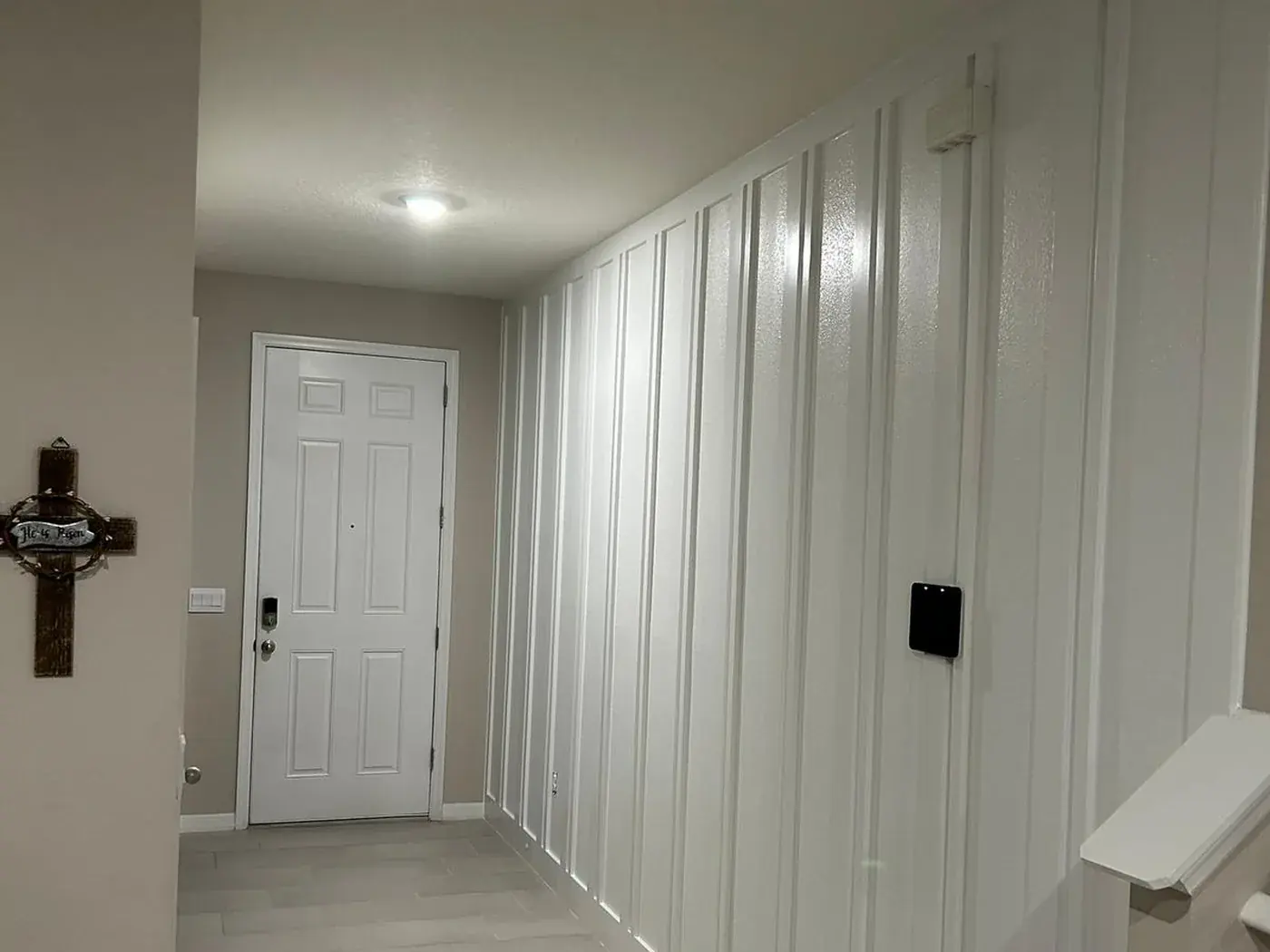
Most Florida homes built after the nineties have large, flat, knockdown-textured walls. They are easy to build and they photograph as nothing at all. Adding vertical battens, a panel grid or a wainscot gives a room shadow lines and proportion, and it does so on one wall rather than all four.
The work is carpentry first and painting second. The layout has to be set out properly, the battens have to land where the eye expects them, and every joint has to disappear under filler and caulk. Done badly it looks like trim stuck on a wall. Done properly it looks like the house was built that way.
What the job includes
- Layout set out on the wall first — spacing worked out around outlets, switches, doors and the stair rail before anything is cut
- Battens cut and fixed to the wall, scribed where the floor or ceiling is out of level
- Nail holes filled, joints caulked — this is the step that decides whether the wall looks built or stuck on
- Knockdown texture bridged where a batten crosses it, so the edge reads as a clean line rather than a ragged one
- Primer and two finish coats in a trim-grade enamel that takes knocks in a hallway
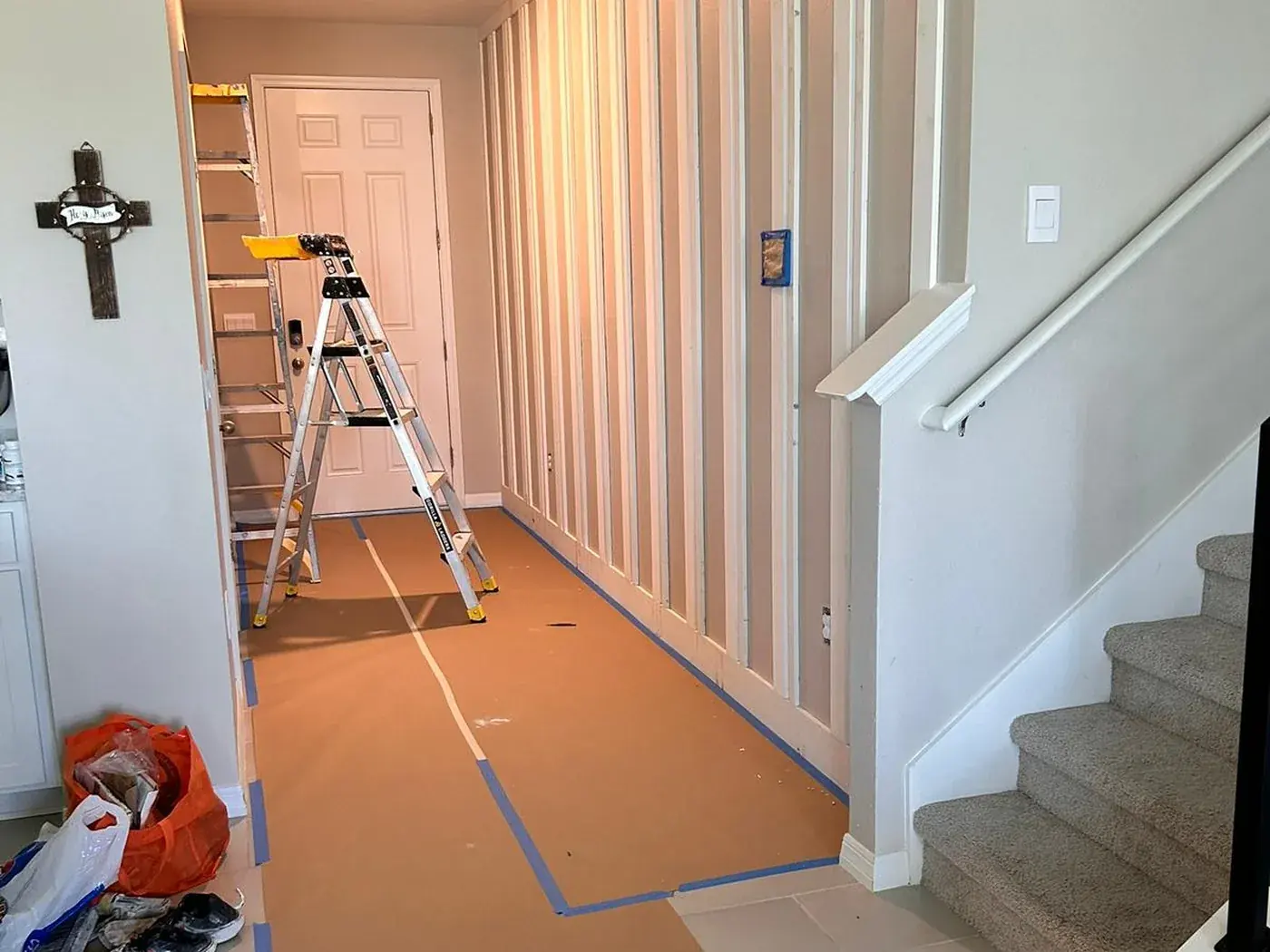
- Floors papered and taped, furniture moved and covered, and the room put back the way it was
Which wall, and which pattern
Entry halls and stair walls are the usual choice, because everyone walks past them. Dining walls and the wall behind a bed are next. A living room wall with a TV on it is usually a poor candidate — the screen fights the pattern.
Vertical board and batten suits a hallway and makes a low ceiling read taller. A full-height square grid suits a dining or living wall. Wainscot at chair-rail height suits a room where you still want most of the wall in color. We will walk the room with you and mark out the option that fits.
How long does it take?
A typical single wall is two working days — one for layout, cutting and fixing, one for filling, caulking and painting. A hallway that runs the full length of a house takes longer, and the caulking day is not one to compress.
What actually goes into a board and batten wall
Board and batten is trim work. Vertical battens fastened to an existing wall, usually with a top rail and sometimes a narrow ledge, then caulked, filled and painted so the assembly reads as one surface. Nothing about it is structural. It carries no load and does not touch framing.
Material choice matters more than people expect. Primed MDF is the standard for dry interior rooms: it machines clean, takes paint beautifully, and costs less than wood. It also swells permanently once wet, which rules it out of a poorly ventilated bathroom and out of a lanai entirely. Primed finger-jointed pine tolerates occasional moisture better. Cellular PVC is the only material we will install somewhere genuinely damp.
Typical batten widths run two and a half to three and a half inches, with a wider board at the top. Thickness is usually half an inch or five-eighths, which throws a shadow line without fighting existing baseboard and casing.
For a board and batten accent wall Port Charlotte or Punta Gorda living room, the decision that changes the room most is height. Full wall, two-thirds, or a chair-rail band all read differently under an eight foot ceiling.
Laying out battens so the wall looks intentional
Spacing is where these walls are won or lost. Battens set out on a round number, every sixteen inches say, usually leave an awkward partial bay at one end. We measure the real wall, subtract the total batten width, and divide the remainder into equal bays so both end spaces match. Where there is a door or window, the layout relates to it.
Outlets and switches land in the way often enough to plan around. A batten that would cover an outlet gets shifted, or the plate gets a box extender so it sits flush with the new surface. Either is fine. Notching a batten around a cover plate is not.
Existing texture is the other question to settle early. Knockdown inside an open bay still looks like knockdown, and in a house where every other wall is textured that is usually fine. For the flat millwork look the bays need skim coating and sanding first, a real addition to the price, so we quote it as its own line.
Ceiling height and furniture drive the rest. Behind a bed, battens running to around sixty inches sit well. Behind a sofa, a top rail near picture-rail height gives the wall a horizon.
Fastening, filling and painting for a seamless finish
Battens go up with construction adhesive plus eighteen gauge brad nails, which holds them tight to a wall that is never perfectly flat. In CBS houses the drywall sits on furring strips, so the brads need something to bite into and we probe before setting a layout. The adhesive carries the load; the nails hold it while it cures.
Then the slow part, which is most of the labor. Every edge gets caulked with paintable acrylic latex and tooled, then left to skin over. Nail holes get lightweight spackle, sanded at 220 grit. MDF cut ends are thirsty and fuzzy, so each one is primed on its own first, or the ends stay chalky under any number of topcoats.
The finish is a waterborne alkyd or acrylic trim enamel in satin or semi-gloss, brushed and rolled or sprayed. Trim sheen against a flat wall is what makes the assembly read as millwork rather than sticks glued to drywall. Where the room's trim and millwork is already a specific white, we match it.
Cure time runs longer than dry time. Enamel handles light contact after a day but keeps hardening for weeks, and in August that stretches. Leaning a headboard against a fresh batten on day two leaves a mark.
Accent colors, resale value and community rules
Color on an accent wall is one of the few places in a house where being bold costs almost nothing to reverse. One wall, one gallon, a weekend. Still, there is a difference between a wall you enjoy living with and a wall that helps you sell.
If the house goes on the market in Venice, Osprey or Fort Myers within the year, we steer away from a saturated accent. Buyers respond to light, consistent and neutral, and a deep navy wall behind the bed becomes one more thing they plan to repaint. Board and batten in the same white as the trim reads as an upgrade instead.
Interior color is nobody's business but yours, even in a deed-restricted community. Architectural review committees deal with exterior surfaces, a different process covered under exterior painting. Inside a condo the rules that apply are practical: working hours, parking, and freight elevator access.
Products we use on trim like this include Sherwin-Williams ProMar 400 as a contractor line, Behr Premium Plus, and Benjamin Moore or Florida Paints where a specific color calls for one. Every job starts with a free estimate and a written fixed price, with a one year workmanship warranty on the scope in that quote.
What people ask about accent walls & board and batten
Do you build the panelling as well, or only paint it?
Both. The battens are cut, fitted and fixed on site, then filled, caulked and painted. It is one job with one person responsible for how it looks at the end.
Will it work over <a href='/drywall-repair/'>knockdown texture</a>?
Yes. The battens sit on the texture and the edges are caulked so the line is clean. If you want the panel fields themselves smooth rather than textured, that is a skim coat first and we will price it separately.
What does an accent wall cost?
It depends on wall size, pattern and ceiling height far more than on paint. The pricing page gives the ranges we see locally. A single feature wall is normally a one to two day job.
Can you match the trim colour already in the house?
Yes. If you know the colour we use it; if not, we match the existing trim so the new work does not read as a slightly different white.
Does it add value or just look good?
Honestly: it is a presentation change, not a structural one. Sellers and agents like it because it makes listing photos look considered. That is a real benefit, but it is not the same as a renovation.
Will board and batten work over a knockdown-textured wall?
Yes, and it is installed that way constantly. The battens sit on top of the texture, and adhesive plus brads handle the unevenness fine. The open bays between them will still show texture, which looks right in a textured house. If you want smooth bays instead, they need skim coating and sanding first, and we price that separately so you can weigh the cost against the difference it makes.
Can we put board and batten on the screened lanai?
Only in cellular PVC, never MDF. A lanai sees driven rain, salt air on Gulf-side elevations and year-round humidity, and MDF will swell and crumble along the bottom edge within a season or two. PVC with coated or stainless fasteners and an exterior-grade acrylic holds up out there. How the rest of that space is handled is covered under lanai and pool deck painting.
Does the existing baseboard stay or come off?
It can go either way. Running the battens down onto the existing baseboard and caulking that joint is simpler, cheaper, and looks correct in most rooms. Removing the baseboard and fitting a taller one that matches the batten thickness gives a cleaner result, costs more, and means working right at the flooring edge. We show both options at the estimate and let the room decide.
The accent wall is behind a wall-mounted TV. Anything to plan for?
Tell us before the layout is set. The mount plate and any cable pass-through need to sit inside an open bay rather than under a batten, and the bracket has to reach the same anchors it uses now.
If the television is already up we can work around the bracket, but taking it down for a day gives a noticeably cleaner result. Running cords inside the wall is an electrician's job, not ours.
Accent Walls & Board and Batten near you
We work across Sarasota and Charlotte counties from our base in North Port, and travel south into Lee and Collier counties on request.
Want a price for accent walls & board and batten?
Send a couple of photos and the address. You get a written fixed quote, usually the same business day.